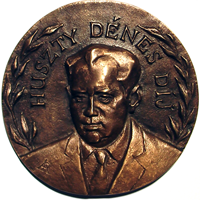
The Board of Trustees issued the call for applications during November of the preceding year and published it in the bulletins of HTE and OPAKFI, on the internet, and on the notice boards of educational institutions. The competition was open to graduates — primarily engineers and physicists — submitting a summary of their independent work, articles published in field-specific journals, or a new paper as the submitted work. Applicants could hold other degrees as well, but their activity had to fall within the field of acoustics.
The Foundation awarded its competition prize for the first time on 18 January 2002, on the occasion of the 75th anniversary of Dénes Huszty's birth.
The priority topic of the competition announced in the first year was the application of the latest results of electroacoustics in studio technology. The Board of Trustees decided that at most two prizes would be awarded in 2002. That year, the Dénes Huszty Memorial Prize consisted of a memorial plaque and a cash prize of 100,000 HUF.
Two applications were received by the stated deadline.
György Wersényi, Chartered Electrical Engineer, entered with the title "HRTFs in Human Localization: Measurement, Spectral Evaluation and Practical Use in Virtual Audio Environment". The English-language paper is the applicant's doctoral dissertation to be submitted in the near future. The outstanding work examines dummy-head sound recording techniques and the subjective reproducibility of headphone listening through modelling of the outer ear, through measurements, and, in part, through examination of the person-dependence of virtual sound source identification. The investigations highlight many novel insights useful also for studio technology. » Curriculum vitae of György Wersényi
Dr. Péter Baranyi submitted an application under the title "Modern control engineering tools in studio technology". The paper's principal aim and significance is to present three methods suitable for broadening the family of studio technology techniques. The first is a control engineering tool that also examines the Lyapunov stability criteria; the second is a systems engineering procedure applicable to automated studio modelling; the third is an intelligent method capable of learning human action–reaction relationships. In the study the applicant also raises the applicability of novel approaches based on fuzzy rules and fuzzy models.
The applications were assessed by an appointed review committee. The chair of the committee was Dr. Géza Gordos, Department Head and Professor; its members were Dr. Ferenc Takács, retired Associate Professor, and Dr. Géza Balogh, Director.
Taking the reviews into account, the Board of Trustees decided to award the prize to both applicants.
The award ceremony was held within the framework of a Memorial Meeting organised by the departments of HTE and OPAKFI, in the presence of the representatives of the founders, on 22 January 2002.
The first announcements concerning the 2002 call for applications are expected in May.