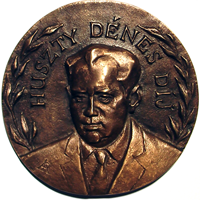
The 20th anniversary of the Foundation is a significant milestone for Hungarian acoustic science and for Hungarian acousticians. Through all the changes, difficulties, and developments of the past 20 years, the Dénes Huszty Foundation — established to support the work of young acousticians and the new generation who choose this specialism as a profession — has continued to operate successfully.
The Dénes Huszty Foundation, established under the Founding Charter of 1 October 2001, was entered into the register by the Metropolitan Court by order no. 11. Pk. 60644/2001/6 under sequence number 8398, and was classified as a foundation of public-benefit status.
Founders: Dr. Gábor Huszty, Entel Műszaki Fejlesztő Kft., the Scientific Association for Infocommunications (HTE), and the Scientific Association for Optics, Acoustics, Motion Pictures and Theatre Technology (OPAKFI).
The aim of the Foundation is to reward outstanding results achieved by young professionals working in the field of acoustics or electroacoustics — thesis students currently completing their higher studies, recent graduates, and young acousticians who have not yet reached their 35th year at the time of application — whose work contributes to the development of acoustics, and not least to that of Hungarian acoustics. By making the results of prize-winning applicants known, supporting related education, and disseminating knowledge, the Foundation carries out public-benefit activities as set out below:
1. Scientific activity, research, research and development (a public duty under Section 5(1)(g) of Act CXXXIV of 2004 on research and development and technological innovation)
2. Knowledge dissemination, education (a public duty under Section 4(1) of Act CXC of 2011 on national public education)
The Foundation carries out its public-benefit activities by presenting the results of acoustics in such a way that they
- assist the unfolding of the convergence of information and communication technologies,
- broaden the professional knowledge of the members of the founding associations through public announcements of competition results, and
- in a manner reflecting the social importance of the field, open up greater scope for young researchers to continue their research work successfully and make it known to the public, and of course
- also help in following developments in the profession and in their rigorous dissemination.
3. Through its public competitions, the Foundation's public-benefit services are available, alongside the members of the founding associations, to all those technical and other higher-qualified professionals who do successful work in the field of acoustics and related disciplines.
4. In pursuit of its public-benefit goals, the Foundation issues annual calls for applications, in order to highlight the technical and economic questions of its specialist field.
5. The Foundation, also through the members of its Board of Trustees, follows the international and domestic results of its specialist field, as well as new technical and technological solutions and methods, and issues its calls for applications in order to transmit and discuss scientific, technical, and economic knowledge.
6. In accordance with its Founding Charter, the Foundation, with the cooperation of the founding associations, ensures the conditions and the publicity needed for carrying out the professional activities related to the competitions.
The Foundation fulfils the above goals by recognising the activities of young professionals with a competition prize. The Foundation operates as follows in pursuit of its aim:
- The Foundation's annual prizes may be applied for by means of a submitted work.
- The Board of Trustees issues the call for applications by 1 November of the year preceding the reference year and publishes it with appropriate publicity.
- Applicants may take part in the competition by submitting a summary of their independent work, articles published in field-specific journals, or a new paper as the submitted work, provided they hold a higher-education diploma, primarily as engineers or physicists. Importantly, applicants may also hold degrees other than in engineering or physics, but their activity must fall within the field of acoustics.
The Foundation does not carry out any business activity.
The key fields of acoustics — electroacoustics, and audiovisual techniques — are increasingly closely connected not only with one another but also with other disciplines; for this reason, the Board of Trustees considered it justified to extend the competition topics to include artificial intelligence, deep learning, and infocommunications.
According to the current call for applications, open for submissions until 21 January 2022, entries may be submitted in the
following topic areas:
- applications of artificial intelligence in digital signal processing,
- the latest possibilities for infocommunication applications of deep learning,
- results achieved in multimedia-communications and acoustics (audiovisual signal processing and transmission, electroacoustics, vibration acoustics, room acoustics, medical acoustics)
presenting the author's own new scientific results, theoretical or practical innovations, or developments.
Looking back on the past two decades, the calls for applications and the prize-winning submissions bring together works and applicants worthy of the Foundation's mission, reflect the interest in the competition of young professionals who practise their profession as a vocation, and enhance the standing of the Dénes Huszty Foundation.
Prize-winning applications at the competitions of the Dénes Huszty Foundation
| Year | Competition topic | Recipient |
| 2001 | The application of the latest results of electroacoustics in studio technology | György Wersényi: HRTFs in human localization. Measurement, spectral evaluation and practical use in virtual audio enviroment. Dr. Péter Baranyi: Modern control engineering tools in studio technology. |
| 2002 | The processing of sound information in electroacoustics, or the latest results of research and development relating to sound quality. | Péter Olaszi: Hungarian text-to-speech conversion, language models, algorithms and their implementation. György Várallyay Jr.: Acoustic analysis of infant cries (TDK paper, Certificate of Merit) |
| 2003 | The latest results on the acoustic questions of speech communication, media informatics, and studio technology | In this year the Foundation did not award a prize |
| 2004 | Informatics methods for solving acoustic problems | András Kocsor: Machine learning and speech representation. Ferenc Márki: Identification of noise sources using the boundary element method. |
| 2005 | Current acoustic problems and modern solutions; acoustic questions of multimedia content services. | Krisztián Gulyás: The present and future of active noise reduction. |
| 2006 | Applications of numerical methods and modelling in vibration acoustics; modern signal processing methods applied to acoustics | Péter Fiala: Modelling soil–structure interaction in the high-frequency range relevant from an acoustic perspective. |
| 2007 | Modern acoustic solutions to acoustic problems. The acoustic aspects of content production and reproduction. | Péter Mihajlik: Machine recognition of spontaneous Hungarian speech without language-specific rules |
| 2008 | Works presenting the author's own new scientific results, theoretical or practical innovations, or developments in topic areas covering the principal fields of acoustics (e.g. engineering acoustics, electroacoustics, theoretical, physical, and vibration acoustics, room acoustics, media informatics, acoustic informatics, medical acoustics). | György Szaszák: The role and use of suprasegmental features in automatic speech recognition. |
| 2009 | Works presenting the author's own new scientific results, theoretical or practical innovations, or developments in topic areas covering the principal fields of acoustics (e.g. engineering acoustics, electroacoustics, theoretical, physical, and vibration acoustics, room acoustics, media informatics, acoustic informatics, medical acoustics). | Tamás Böhm: Analysis and modelling of speech produced with irregular phonation |
| 2010 | Works presenting the author's own new scientific results, theoretical or practical innovations, or developments in topic areas covering the principal fields of acoustics (e.g. engineering acoustics, electroacoustics, theoretical, physical, and vibration acoustics, room acoustics, media informatics, acoustic informatics, medical acoustics). | Péter Rucz: Determination of acoustic parameters of organ pipes by means of numerical techniques. Szilvia Molnár: Acoustic study of the Győr Synagogue and its comparison with the Richter concert hall (Certificate of Merit) |
| 2011 | Works presenting the author's own new scientific results, theoretical or practical innovations, or developments in topic areas covering the principal fields of acoustics (e.g. engineering acoustics, electroacoustics, theoretical, physical, and vibration acoustics, room acoustics, media informatics, acoustic informatics, medical acoustics). | Dr. György Várallyay: PhD dissertation entitled "Analysis of infant cries using objective methods" |
| 2013 | Works presenting the author's own new scientific results, theoretical or practical innovations, or developments in topic areas covering the principal fields of acoustics (e.g. engineering acoustics, electroacoustics, theoretical, physical, and vibration acoustics, room acoustics, media informatics, acoustic informatics, medical acoustics). | Dr. Bálint Pál Tóth: PhD dissertation entitled "Hidden Markov model-based machine speech synthesis" |
| 2014 | Works presenting the author's own new scientific results, theoretical or practical innovations, or developments in topic areas covering the principal fields of acoustics (e.g. engineering acoustics, electroacoustics, theoretical, physical, and vibration acoustics, room acoustics, media informatics, acoustic informatics, medical acoustics). | Dr. Tamás Gábor Csapó: PhD dissertation entitled "Improving the naturalness of machine speech generation in a hidden Markov model-based text-to-speech system" |
| 2016 | Works presenting the author's own new scientific results, theoretical or practical innovations, or developments in topic areas covering the principal fields of acoustics (e.g. engineering acoustics, electroacoustics, theoretical, physical, and vibration acoustics, room acoustics, media informatics, acoustic informatics, medical acoustics). | Gergely Firtha: "Research results in the general theory of sound field reproduction and their application to moving sources" |
| 2017 | Works presenting the author's own new scientific results, theoretical or practical innovations, or developments in topic areas covering the principal fields of acoustics (e.g. engineering acoustics, electroacoustics, theoretical, physical, and vibration acoustics, room acoustics, media informatics, acoustic informatics, medical acoustics). | Dóra Jenei: "Physics-based modelling of piano sound" (MSc thesis, 2016, Budapest University of Technology and Economics, MSc) and 4 articles |
| 2019 | Works presenting the author's own novel scientific results, theoretical or practical innovations, or developments in topic areas covering the principal fields of acoustics and acoustic digital signal processing (e.g. engineering acoustics, electroacoustics, theoretical, physical, and vibration acoustics, room acoustics, media informatics, acoustic informatics, medical acoustics, noise and vibration reduction). | Attila Zoltán Jenei: Possibilities for the automatic speech-based identification of depression using 2D convolutional neural networks |
| 2021 | Works presenting the author's own novel scientific results, theoretical or practical innovations, or developments concerning the applications of artificial intelligence in digital signal processing, the latest possibilities for infocommunication applications of deep learning, or results achieved in multimedia-communications and acoustics (audiovisual signal processing and transmission, electroacoustics, vibration acoustics, room acoustics, medical acoustics). | Competition issued |
The first 20 years of the Dénes Huszty Foundation indicate that, as a result of PhD training, many candidates from the Doctoral School of Electrical Engineering — particularly from the doctoral programmes of the BME Department of Telecommunications and Media Informatics (TMIT) and the Department of Networked Systems and Services (HIT) — took part in the competitions. The achievements of the 18 distinguished young professionals show that, making use of the Foundation's opportunities, leading figures of current front-rank domestic research presented their latest research results within the framework of the Foundation, through summary papers or through already submitted and published work.
Most of the winners of the competition prizes have since obtained the PhD degree and become recognised figures of Hungarian scientific and educational life. Several of them have also received further domestic and international professional recognition and become internationally recognised authorities.
The recognition of the Hungarian profession confirms that the founders' intention has been realised over the first eighteen years: in memory of the outstanding professional work of Dénes Huszty, and in continuation of his aims, young professionals in the field have contributed significantly to the development of acoustic science and of the sector.
Dr. Fülöp Augusztinovicz, Dr. Gábor Huszty, Géza Balogh, Dr. Csaba Huszty
Trustees of the Foundation
Budapest, October 2021