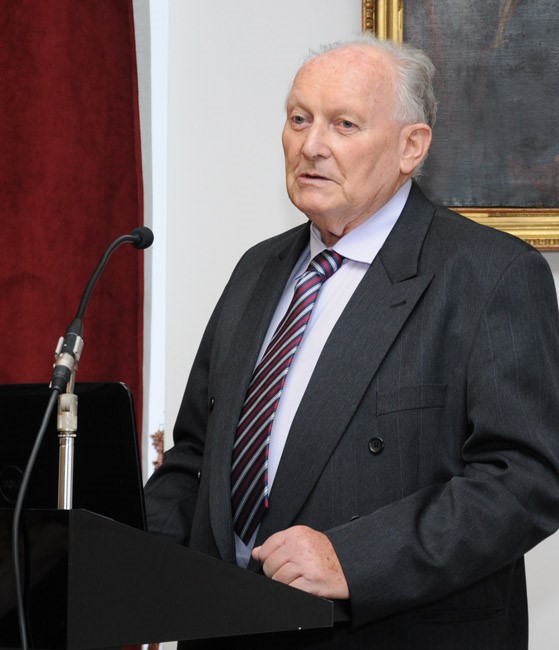
 Dr. András Illényi — candidate of physical sciences, public body member of the Hungarian Academy of Sciences (HAS), recipient of the Farkas Kempelen, György Békésy, and Pro Silentio prizes, physicist and acoustician, Scientific Director and subsequently head of the HAS György Békésy Acoustic Research Laboratory, and senior research fellow at BME TMIT — passed away in his 84th year on 28 May 2016.
András Illényi was born in Budapest in 1932. He graduated in 1956 from the Faculty of Science of ELTE, majoring in mathematics and physics. From 1953 to 1956 he was a trainee at the Postal Experimental Institute; from 1958 to 1964 he worked on audio engineering development tasks as a development engineer at the Electroacoustics Factory (later BEAG). During this period he was also an external collaborator of the HAS Acoustic Research Group from 1955 to 1964. Between 1964 and 1967 he was a HAS aspirant at the Dresden University of Technology, in the department of Prof. Reichardt. From 1968 to 1976 he directed loudspeaker development at BEAG, in the Acoustic Equipment Development Head Department led by Dénes Huszty, serving in research engineer, department head, and deputy head of main department roles. From 1976 to 1991 he was deputy scientific director of the HAS TTKL György Békésy Acoustic Research Laboratory. From 1992 to 1996 he was Scientific Director of the György Békésy Acoustic Research Laboratory, part of the HAS Natural Sciences Research Laboratories. Following the Academy's reorganisations in 1995, András Illényi continued to lead the Laboratory in affiliation with the Department of Telecommunications and Telematics of the Budapest University of Technology, where he also took an active role in teaching.
His work extended to most branches of the most widely cultivated domestic field of acoustics. His principal area of interest was the physics of the sound field and the measurement and perception of its physical parameters, determined by objective measures. At the HAS Acoustic Research Laboratory he was a colleague of Dr. Tamás Tarnóczy; from 1981 until his retirement in 2002 he worked as head of the György Békésy Acoustic Research Laboratory. Patents relating to vibration diagnostics from this period of his work gave rise to simple hand-held instruments as well as portable and permanently installed composite vibration diagnostic systems. For ten years, the Laboratory he headed served the vibration measurement needs of numerous Hungarian companies (Paks Nuclear Power Plant, Pécs Thermal Power Plant, Dunamenti Thermal Power Plant, and Budapest Thermal Power Plant). He also did substantial work in the field of standardisation: together with other foreign laboratories, he took part in an international round-robin study during the drafting of the ISO 3740 family of international standards (determination of sound power on the basis of sound pressure measurement). It was during this period that the MSz 18150 standard family (Environmental Noise Measurement and Evaluation), of major importance for Hungarian noise protection, was compiled. In the drafting of these standards and of other noise protection laws, regulations, and studio technology standards, the Acoustic Research Laboratory under his direction — together with other Hungarian laboratories — provided the professional and scientific background.
His research areas included the objective and perceptual characteristics of sound, holophonics, engineering psychoacoustics, and the practical applications of acoustics, within which the analysis of the acoustic information of infant cries. He was author or co-author of 4 book chapters and 116 publications, and of 8 patents accepted in a total of 59 countries, and took part in the development of more than 330 acoustic constructions and design documentations.
A member of OPAKFI from 1957, he served on the leadership of the acoustics department for nearly 50 years, and on the leadership of the noise department for 30 years. He was chair of the association's scientific committee from 1996 to 2006. For close to ten years he also held the position of chair of the György Békésy Prize Committee.
Over the past 40 years he took part in the organisation of every acoustic professional event of OPAKFI, as well as of several noise and vibration protection conferences. He was also an active leadership member of the ICA 1971, ACTIVE 1997, and FORUM ACUSTICUM 2005 international congresses. Between 1965 and 1995 he was acoustics editor of Kép és Hangtechnika; from 1964 he was editor, and from 1996 to 2001 editor-in-chief, of Akusztikai Szemle. In recognition of his work, he received the gold grade of the György Békésy Prize in 2008. Candidate of physical sciences (1980). PhD 1996 (BME). Outstanding Inventor (1974, 1975, 1977), György Békésy Prize (1983), Pro Silentio Prize (1990), Farkas Kempelen Prize (1995), MTESZ Prize (1997).
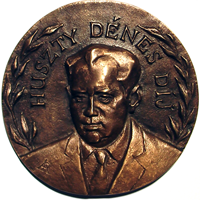
From 1969 he was a member of the HAS Acoustic Complex Committee, deputy chair from 1981 to 1994, and chair between 1994 and 1997 and in 2002. From 2002 to 2006 he was chair of the scientific committee of the Scientific Association for Optics, Acoustics, Motion Pictures and Theatre Technology (OPAKFI). Member of the Acoustical Society of America (ASA) from 1997; member of the German Acoustic Society (DAD) from 1992; member of the Audio Engineering Society from 1988; board member of the International Institute of Noise Control Engineering (I-INCE). From 1998 to 2004 he was a member of the Chamber of Engineers (SZÉS-4-b acoustics, specialist designer). Chair of the MSZT Noise Technical Committee. The Dénes Huszty Foundation was established in 2001 to recognise young engineers. From its founding until his death he was a member of the Board of Trustees, and Chair of the Board until 2012.
In August 1997 the INTER-NOISE'97 Congress, with 700 participants, was held; he was chair of its organising committee. In recognition of his work he was a board member of I-INCE (International Institute of Noise Control Engineering) for six years.
Principal works: Sound radiator (US Pat. 3,648,801); Holophonics, a spread out of the basic ideas on Holography into Audio-acoustics (in Holography, ed. P. Greguss, T.H. Jeong, SPIE Vol. IS 8, Washington 1990); Engineering psychoacoustics, BME notes 2002 (CD); Handling of acoustic information, BME notes 2006.
With heavy hearts we bid farewell to him — an outstanding colleague and researcher, a man of universal respect and affection who led an exemplary life. May he rest in peace.
Éva Arató Dr. Géza Balogh Dr. Gábor Lupkovics
Head of the Acoustics Department, OPAKFI Chair of the Scientific Committee, OPAKFI Chair, OPAKFI